Key Takeaways
A first gym session does not need to be complicated or exhausting. I can make the experience more comfortable by arriving with a simple plan, moving with control, and leaving enough energy to recover well.
- Choose a realistic session length and keep the first workout manageable.
- Warm up gradually with light cardio, joint movement, and easy practice repetitions.
- Use simple full-body exercises that cover the legs, back, chest, hips, and core.
- Rest as needed and finish each set while good technique is still available.
- Record what I did so the next session feels familiar rather than uncertain.
Set yourself up for a successful first gym session
A little preparation can remove much of the uncertainty from a first visit. I do not need to know every machine or have a perfect programme before walking through the doors. I only need enough structure to move calmly, learn the space, and complete a sensible amount of work. This first gym session plan is a starting point, not a test of how much I can endure.
Choose a realistic time and workout length
I would choose a time when I am unlikely to be rushed, distracted, or already worn out. For a first visit, a shorter session is often easier to manage than an ambitious one that leaves me overwhelmed. I can allow time to find the changing area, locate equipment, and pause when I need to think. A session can still be worthwhile even if I finish earlier than expected.
I also like to decide in advance what “done” means. That might be a warm-up, five simple exercises, and a cool-down. Having a clear finish line helps me avoid wandering from machine to machine or adding exercises simply because I feel I should be doing more.
Pack the essentials
A small gym bag is enough for most first sessions. I would bring comfortable clothing, supportive shoes, water, a towel if the gym requests one, and anything I need for getting home afterwards. It is also useful to have a note on my phone with the exercise names, because remembering a plan while learning a new space can be harder than expected.
The basics can be grouped quite simply:
- Comfortable clothes that allow my hips, shoulders, and knees to move freely.
- Shoes that feel secure when I walk, squat, and use resistance equipment.
- Water and a towel, according to the gym’s facilities and rules.
- A phone note or small notebook for recording exercises and settings.
This keeps the bag practical rather than turning it into another source of preparation anxiety. If I forget something non-essential, I can usually continue with the session instead of treating the omission as a reason to leave.
Learn the gym layout and equipment
When I arrive, I would take a few minutes to notice where the cardio machines, resistance equipment, free weights, toilets, water stations, and exits are located. I can also check whether equipment needs to be wiped down before or after use. This brief orientation makes it easier to move between exercises without feeling as though everyone is watching me.
I do not need to use every type of equipment on the first day. It is enough to identify one suitable option for each movement and ask staff for an explanation if a machine is unfamiliar. A quiet, careful beginning is usually more useful than trying to appear experienced.
Set a comfortable effort level
I would aim for an effort that feels purposeful but leaves room for control. The first session is a chance to learn how my body responds to exercise, not an opportunity to prove my maximum strength. I should be able to complete repetitions without holding my breath, rushing, or changing position to force the weight upwards.
A useful rule is to finish a set feeling that I could have performed a few more clean repetitions. That approach gives me space to practise the movement and makes it easier to recover before the next visit. Control matters more than intensity while I am still learning the basics.
Warm up your body and prepare to move
A warm-up gives me time to shift from ordinary daily movement into exercise. I use it to raise my temperature gradually, explore how my joints feel, and rehearse the patterns I will use in the workout. It should make the first working set feel more familiar, not leave me tired before strength work begins. I keep the pace easy enough that I can breathe comfortably and pay attention.
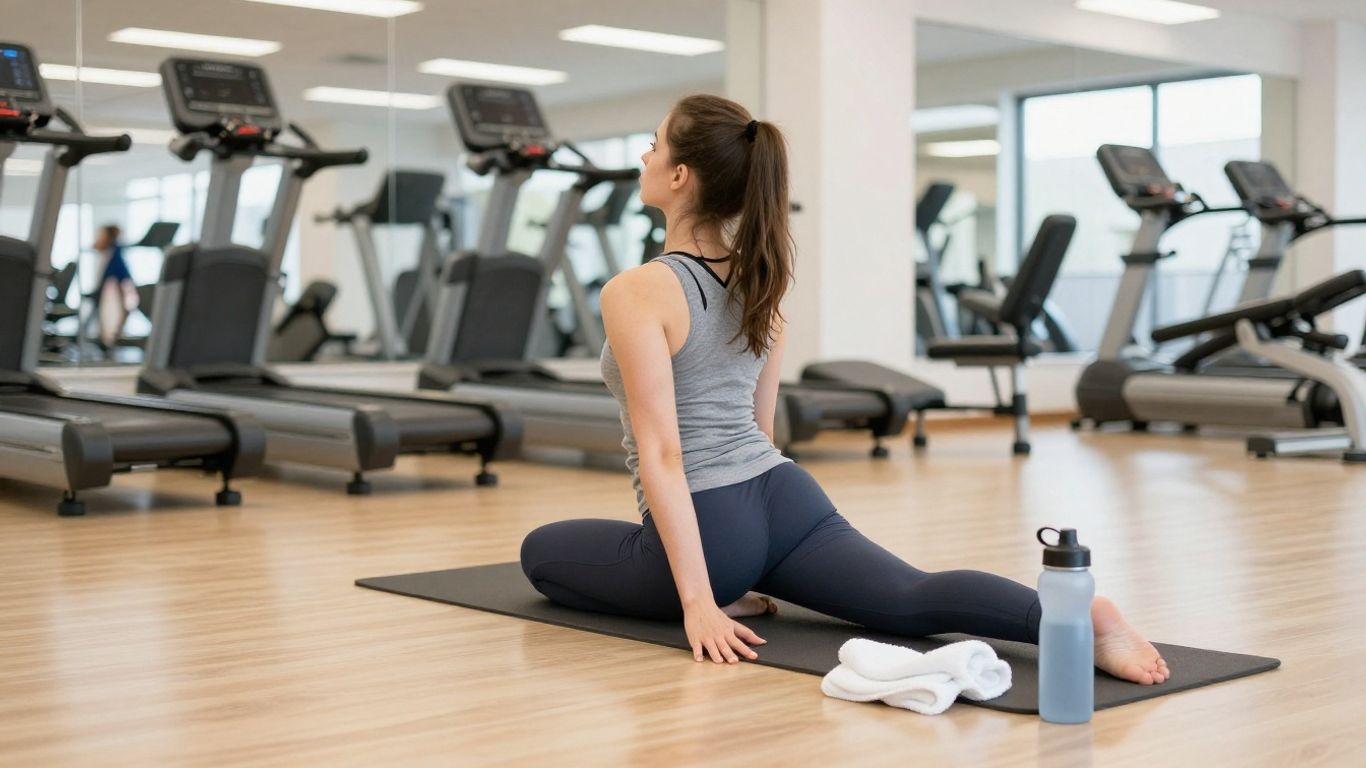
Start with light cardio
I might begin with a treadmill walk, stationary bike, cross-trainer, or another familiar option. The aim is gentle, steady movement rather than a hard cardio effort. I would start slowly, adjust the settings to feel secure, and increase the pace only if my body feels ready.
During this part, I notice whether my shoes feel stable and whether the equipment is set up comfortably. If I feel unusually breathless or unsteady, I slow down or stop rather than trying to push through it. The warm-up should leave me more prepared, not depleted.
Mobilize your major joints
After light cardio, I can move through a few comfortable ranges without forcing a stretch. Shoulder circles, gentle arm swings, ankle movements, and slow hip shifts are simple ways to bring attention to the areas I will use. I keep the movements smooth and avoid bouncing into positions that feel sharp or restricted.
This is also a useful moment to check how I am feeling that day. One side may feel tighter, or I may notice that I need a slower transition between movements. I can use that information to adjust the session instead of ignoring it.
Practice basic movement patterns
Before adding weight, I would rehearse a bodyweight squat, a hip hinge, a gentle row motion, and a braced plank position. These practice repetitions are not meant to be a workout by themselves. They help me understand where my feet, hands, spine, and shoulders need to be before the equipment adds complexity.
I can practise each pattern slowly and use a mirror only as a secondary check. My main focus is how the movement feels and whether I can repeat it without losing balance. If a pattern is confusing, I would simplify it or ask a staff member to show me a safe setup.
Know when to extend or shorten the warm-up
I may need a little longer if I have been sitting for much of the day, feel stiff, or am learning several unfamiliar movements. On another day, a short warm-up may be enough if I already feel mobile and alert. I do not need to follow the same duration every time; I can let the quality of my movement guide me.
The warm-up is complete when I feel ready to work, not when I have accumulated a particular number of minutes. If discomfort increases, I stop that movement and reconsider the exercise rather than extending the warm-up in the hope that the feeling will disappear.
Follow a beginner-friendly full-body workout
A full-body session allows me to practise several useful movement patterns without needing a complicated split routine. I can choose one option from each pair below, complete a modest number of sets, and focus on learning the setup. The exercises are deliberately familiar and adaptable, so I can use machines or simpler bodyweight versions according to what feels clear in the gym.
I would move from one exercise to the next at an unhurried pace. There is no need to race, and I can reduce the range of motion or choose the easier option if the full version does not feel stable. The goal is to finish knowing what each movement was supposed to feel like.
Leg press or bodyweight squat
The leg press offers back support and a defined path, while a bodyweight squat lets me practise moving without selecting a load. For the leg press, I would place my feet in a comfortable position, keep my back against the pad, and lower the platform only as far as I can maintain control. I would avoid locking my knees forcefully at the top.
For a bodyweight squat, I can stand with my feet at a comfortable width, send my hips down and back, and keep my whole foot connected to the floor. I do not need to squat deeply if that makes my balance or posture change. A smaller, steady movement is a sensible place to begin.
Seated row or cable row
A seated row trains a pulling pattern that I can approach with a light resistance. I would sit tall, set my feet securely, and draw the handle towards my body without leaning backwards to create momentum. The return should be slow enough that I can feel the weight moving under control.
If I use a cable row, I would check that the attachment is secure and that the cable path feels clear. I keep my shoulders relaxed rather than shrugging them towards my ears. The exercise should feel like a controlled pull, not a tug produced by the lower back.
Chest press or incline push-up
A chest press machine can provide a straightforward way to practise pushing. I would set the seat so the handles sit around chest level, choose a light resistance, and press without snapping my elbows straight. I would bring the handles back slowly and stop if my shoulders feel pinched or unstable.
An incline push-up is another option because the raised surface reduces the amount of bodyweight I need to move. I can place my hands on a stable bench or bar, keep my body in one long line, and lower myself only as far as I can control. The surface must not move beneath me.
Dumbbell Romanian deadlift
This exercise teaches a hip-hinge pattern. I would hold light dumbbells close to my legs, soften my knees, and send my hips backwards while keeping the weights near my body. When I feel a gentle stretch through the back of my legs, I would press through my feet and return to standing without leaning backwards.
The movement should come from the hips rather than from rounding my back towards the floor. I can practise the hinge without dumbbells first if the pattern is unfamiliar. There is no benefit in choosing a heavier weight before I can repeat the motion smoothly.
Plank or dead bug
For a plank, I can use my hands or forearms and keep my body aligned while gently bracing my middle. I would stop the hold when my hips begin to sag or lift, rather than treating a longer duration as automatically better. A short, well-held position is enough for a first attempt.
A dead bug may feel more manageable if holding a plank is uncomfortable. Lying on my back, I can move one arm or leg at a time while keeping the movement slow and my lower body controlled. I would use the version that lets me breathe normally and maintain a steady position.
Use the right sets, reps, and rest periods
The numbers in a beginner programme are less important than the quality of each repetition. I can begin conservatively, learn how the exercise feels, and adjust at the next session. A first workout should provide practice without making recovery unnecessarily difficult. If I am unsure, I would choose less resistance and ask for guidance rather than guessing.
The table below gives a simple starting framework. It is not a test or a fixed rule; I can use fewer repetitions when technique starts to deteriorate or take more rest when I need it.
Select a manageable starting weight
I would test a very light load before deciding whether it is suitable. The first repetitions should feel smooth, and I should be able to place the weight down safely at the end. If I need to swing, jerk, or hold my breath to move it, the load is probably too demanding for a learning set.
A simple guide for the first session might look like this:
| Exercise type | Starting approach | Resting approach | What I am checking |
|---|---|---|---|
| Leg press or squat | Light load or bodyweight | Pause until breathing settles | Stable feet and controlled depth |
| Row variation | Light resistance | Rest before grip or posture fades | Shoulders stay relaxed |
| Chest press or incline push-up | Easy resistance or raised surface | Take a comfortable pause | Smooth pressing path |
| Hip hinge | Very light dumbbells or no load | Reset before each set | Hips move back without rounding |
| Plank or dead bug | Short, controlled effort | Stop before alignment changes | Steady breathing and bracing |
After using this framework, I can record what felt easy, challenging, or unclear. That note is more useful than trying to compare my numbers with someone else’s, because it gives me information about my own starting point.
Complete controlled repetitions
I would choose a pace that allows me to notice the beginning, middle, and end of every repetition. The weight should not drop suddenly, and I should not rely on bouncing to get through a difficult point. If I cannot control the return phase, I would reduce the resistance or stop the set.
Repetitions do not need to be perfectly slow. They simply need to be deliberate enough that I can keep the intended position. I am practising a skill as well as creating effort, so consistency matters more than chasing a particular number.
Rest between exercises
Rest gives me time to recover my breathing, reset the equipment, and think about the next movement. I can sit or stand quietly, take a drink, and check that my posture and grip are ready before starting again. Rushing from one exercise to the next often makes technique less reliable.
I would take more time after a demanding lower-body movement and less time after an easy set, but I would not treat short rests as a measure of fitness. A calm session with sensible pauses is a stronger foundation than a hurried circuit that leaves me confused.
Stop with good form still intact
I would finish a set when my alignment, range, or control begins to change. Mild effort and muscle fatigue can be expected during exercise, but sharp pain, sudden weakness, dizziness, or a feeling that something is wrong are reasons to stop. I can ask a qualified gym professional for help if I am uncertain about what I am feeling.
Stopping early is not a failure. It means I have noticed the point at which the exercise stopped being useful practice. I can write down what happened and return to it with a lighter option or clearer instruction another time.
Learn proper gym exercise technique
Good technique is not a single perfect shape that I must achieve immediately. It is a repeatable position that suits my body, the equipment, and the exercise I am performing. I learn best when I set up carefully, move through a comfortable range, and make one small adjustment at a time. Patience here makes the rest of the session feel less intimidating.
I also remind myself that gym equipment is adjustable. Seat heights, handles, pads, and cable positions are not universal, so copying the settings of the person beside me may not be appropriate. I take the time to make the station fit me.
Adjust machines to fit your body
Before starting, I would check the seat, back pad, handles, and any safety stops. My joints should not feel forced into an awkward position, and I should be able to reach the handles without stretching or twisting. I would test the movement with little or no resistance before beginning a working set.
If I cannot understand the adjustment points, I would pause and ask gym staff to explain them. It is better to spend a minute learning the controls than to begin while guessing. Once the machine is set, I can note the position for next time if it feels comfortable.
Keep your posture stable
A stable posture does not mean making my body rigid. It means keeping the parts that should remain steady from moving unnecessarily while the target joints do the work. I would keep my feet planted where appropriate, allow my spine to stay in a natural position, and avoid using momentum to finish a repetition.
I can reduce the load or range if I notice my shoulders lifting, my back rounding, or my knees moving in a way I cannot control. Small changes often make an exercise feel much clearer. I do not need to force a position that does not suit my current mobility.
Breathe through each repetition
I would breathe naturally and avoid holding my breath for the entire set. Exhaling during the effort and breathing in as I return can provide a useful rhythm, although comfort and control come first. If I lose that rhythm, I take a pause and reset instead of rushing through the next repetition.
Breathing also gives me information about effort. If I cannot recover enough to speak comfortably during a rest, I would extend the pause and consider reducing the intensity. The first session is a poor time to see how far I can push my limits.
Ask for help when an exercise feels unclear
I can ask staff to show me how a machine works, where to place my feet, or whether a setting looks suitable. A clear question is enough: I might explain that I am new to the exercise and would like a quick check of the setup. Most gyms expect newcomers to need orientation.
I can also choose a simpler alternative if help is not immediately available. There is no requirement to complete a particular movement on a particular day. Understanding what I am doing is more valuable than forcing an exercise because it appears on a note in my phone.
Finish with a cool-down and recovery routine
The end of the session should feel gradual rather than abrupt. I use the cool-down to lower the pace, release some tension, and decide how my body feels after the workout. Recovery begins before I leave the gym, with a few calm minutes and a plan for food, fluids, and rest. This helps me treat the session as one part of a routine rather than an isolated challenge.
I keep the cool-down simple and avoid turning it into another demanding workout. The aim is to leave feeling settled enough to continue with the rest of my day.
Gradually lower your heart rate
I might walk slowly on a treadmill or pedal gently on a bike for a few minutes. I reduce the pace in stages instead of stopping suddenly after a hard effort. As my breathing settles, I can pay attention to whether I feel comfortable, unusually tired, or ready to head home.
If I feel light-headed or unwell, I stop and sit somewhere safe, and I tell gym staff what is happening. I do not try to hide symptoms simply because the planned workout is finished.
Add gentle stretches
I can choose a few comfortable stretches for the muscles I used, holding each position without bouncing or forcing extra range. A gentle stretch should feel mild and manageable, not sharp. I breathe steadily and release the position if it becomes uncomfortable.
Stretching is optional rather than a punishment for not being flexible. A few easy movements may help me feel more settled, but I do not need an elaborate sequence before leaving. The main priority is finishing the session in a calm state.
Rehydrate and eat a balanced meal
I would drink water according to my thirst and the conditions around the workout. If I am hungry afterwards, a normal balanced meal or snack can provide a practical combination of carbohydrates, protein, and other foods I enjoy. I do not need special products to make a first session count.
I also consider the timing of my next meal. Planning something simple before I leave can prevent me from arriving home overly hungry and choosing food in a rush. Recovery is easier when the basics are convenient.
Notice soreness versus warning signs
Some muscle tenderness can appear after a new activity, particularly in areas that have not worked in that way recently. I would pay attention to how the feeling changes and avoid training through pain that is sharp, severe, or worsening. Swelling, unusual weakness, or symptoms that concern me deserve appropriate professional attention.
I do not diagnose an injury from a gym session. If something feels wrong or does not settle, I would stop the relevant exercise and seek advice from a suitably qualified health professional. It is sensible to be cautious when I am unsure.
Build your next steps after the first session
The first workout gives me useful information, even if it does not feel perfect. I learn which equipment was comfortable, which movements need more explanation, and how much energy I had at the end. I can use those observations to make the next visit slightly easier to navigate. Progress begins with returning to a routine that I can actually maintain.
I would resist changing everything at once. Keeping a few exercises consistent makes it easier to notice improvements in technique and confidence, while small adjustments keep the plan appropriate for my current energy.
Record the exercises and weights used
After the session, I would note the exercise, the variation, the resistance, and how the set felt. I can also record whether the machine was comfortable or whether I need to ask about its setup next time. These details turn a vague memory into a useful reference.
My notes do not need to be elaborate. A short record such as “light row, steady control, check seat next time” is enough to guide me. It also gives me permission to start from where I actually am rather than guessing.
Schedule your next workout
I would choose a day that gives me enough time to recover and fits around work, family, sleep, and other commitments. The best schedule is one I can repeat, not one that looks impressive on paper. I can put the appointment in my calendar and prepare the bag the night before if that reduces friction.
If the next visit needs to be postponed, I do not treat that as abandoning the plan. I simply choose another realistic time. Consistency is built from returning after ordinary interruptions.
Increase difficulty gradually
When an exercise starts to feel familiar, I can change one factor at a time. That might mean adding a small amount of resistance, completing an additional controlled repetition, or using a slightly more challenging variation. I would wait until the current version feels stable before making it harder.
I also keep an eye on the following session rather than judging success by one energetic day. If the adjustment makes technique unreliable or recovery much harder, I can return to the previous level. Progress is allowed to move in both directions while I learn.
Adjust the plan around your goals and energy levels
My plan may change depending on whether I want to build general strength, become more comfortable with gym equipment, support another activity, or simply establish a movement habit. I can keep the basic structure and adjust the exercise choices to suit those priorities. The important thing is to stay honest about what I can do consistently.
Energy will vary, too. On a tired day, I might reduce the load, take longer rests, or complete fewer exercises. On a good day, I can still choose restraint and leave with enough energy for tomorrow. A flexible plan is more useful than one that only works under perfect conditions.
Frequently Asked Questions
How long should my first gym session be?
I can keep it short enough to include a warm-up, a handful of full-body exercises, and a cool-down without feeling rushed. A manageable session is preferable to one that leaves me exhausted or confused about what to do next.
Should I use machines or free weights first?
Either can work. Machines may offer a more guided path, while light dumbbells or bodyweight exercises can help me learn basic movement patterns. I should choose the option I can set up safely and understand clearly.
How many exercises should a beginner do?
A small selection covering the lower body, pulling, pushing, hinging, and core is enough for a first visit. Adding more exercises is not necessary if my technique, concentration, or energy is already fading.
How much weight should I lift?
I should choose a load that allows controlled repetitions without swinging, straining, or losing posture. Starting lighter gives me room to learn the movement, and I can adjust the resistance after I understand how the exercise feels.
What should I do if I feel embarrassed at the gym?
I can follow a written plan, use familiar equipment, and take my time between exercises. Most people are focused on their own routines, and asking staff for help is a normal part of learning the space.
Is muscle soreness after a first workout normal?
Some tenderness may occur after unfamiliar exercise, but sharp, severe, or worsening pain is different from ordinary post-workout soreness. I should stop a movement that feels wrong and seek suitable professional advice if I am concerned.
How soon should I train again?
I can schedule the next session when I feel recovered enough to move with control and when the timing fits my normal routine. I do not need to rush back simply to prove commitment; steady, manageable visits are a better foundation.