Key Takeaways
A calm, simple plan can make a first gym visit feel much less intimidating. I would focus on learning the space, moving with control, and leaving with enough energy to return.
- Set aside a realistic amount of time rather than rushing.
- Warm up gently before using resistance machines or weights.
- Train the major movement patterns with manageable resistance.
- Rest whenever your breathing or technique starts to deteriorate.
- Record what you did so the next session feels familiar.
Set yourself up before you arrive
A little preparation removes many of the awkward decisions that can make a first visit stressful. I like to decide what I will do before walking through the doors, while leaving enough flexibility to change an exercise if equipment is busy. The aim of this first gym session plan is not to prove anything; it is to create a comfortable starting point.
Choose a realistic time and workout length
Choose a time when I am unlikely to be distracted, exhausted, or pressed for another appointment. For a first session, I would allow enough time to look around, warm up, complete a few exercises, and cool down without hurrying. A shorter session that feels manageable is more useful than an ambitious one I dread repeating.
I can also decide on a simple finishing point before I begin. If I have completed the planned movements with steady technique, I have done enough for the day.
Pack the essentials and wear comfortable clothing
I would pack a water bottle, a small towel if the gym requests one, and clothing that allows my shoulders, hips, and knees to move freely. Supportive footwear with a secure fit is helpful, particularly when using standing exercises. I do not need specialised equipment to learn the basics.
Keeping the bag simple makes it easier to arrive without fuss. I can also bring a note on my phone with the exercise order, although I should keep it out of the way when moving around the gym.
Learn the gym layout and key safety rules
Before training, I would locate the reception desk, toilets, drinking fountain, changing area, and emergency exits. I would also notice where weights are returned and whether machines have instructions attached. A brief orientation from staff can make the room feel more familiar straight away.
I should keep walkways clear, avoid leaving weights where someone could trip, and ask before taking equipment that another person is using. Good gym manners are part of feeling confident in the space.
Decide what you want to accomplish
For a first visit, my goal might be learning five exercises, becoming comfortable with the machines, or simply completing a full-body session without rushing. A clear, modest goal gives the workout shape while avoiding pressure to do everything at once. I can judge success by how well I followed the plan, not by how sore I feel afterwards.
Writing down that goal before I leave home gives me something concrete to return to. It also helps me choose exercises that match the purpose of the session.
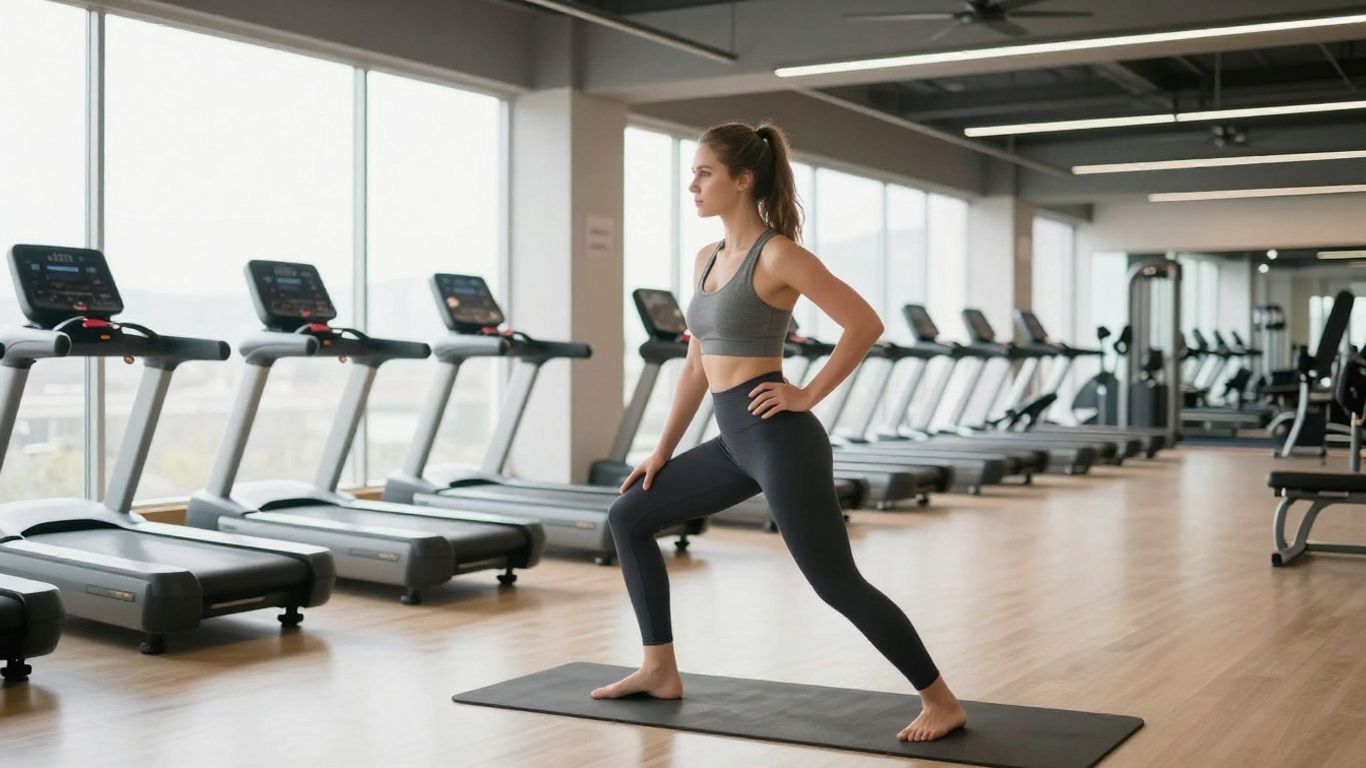
Warm up your body and prepare to move
A warm-up gives me time to shift attention from the day into the workout. I start gently, notice how my body feels, and use the first few minutes to rehearse the movements I plan to perform. The warm-up should prepare me, not drain the energy I need for the session.
Start with light cardio
I can begin with an easy pace on a treadmill, stationary bike, cross-trainer, or rowing machine. The purpose is to raise my temperature gradually and practise moving smoothly, rather than chasing a hard effort. I should be able to speak in short sentences while I warm up.
After a few minutes, I can slow down or stop if I feel ready to move on. The best choice is the machine that feels stable and straightforward on the day.
Mobilize the joints you will use
I would gently move my ankles, knees, hips, shoulders, and upper back through comfortable ranges. Slow arm circles, bodyweight squats to a shallow depth, and controlled hip movements can help me explore how each area feels. I avoid forcing a stretch or bouncing into a position.
This part does not need to become a separate workout. A few deliberate movements are enough to prepare the joints for the exercises ahead.
Practice basic movement patterns
Before adding resistance, I can rehearse sitting down and standing up, pushing, pulling, bending at the hips, and bracing my middle. These simple patterns help me understand the shape of the exercises and reveal any movement that feels unfamiliar. I would use a wall, bench, or machine for support if that makes the practice steadier.
The rehearsal also gives me a chance to adjust my stance and breathing. I would rather spend another moment learning the pattern than begin with a load I cannot control.
Know when to reduce the intensity
If I feel dizzy, unusually breathless, sharp discomfort, or a sudden loss of coordination, I would stop and rest. Heavy fatigue is not a requirement for a useful warm-up. I can reduce the pace, switch to a gentler movement, or end the session if my body is not responding normally.
If a symptom worries me or does not settle, I should seek appropriate professional guidance rather than trying to push through it. Listening early is a sensible part of training.
Follow a beginner-friendly full-body workout
A full-body session lets me practise several useful movements without needing a complicated schedule. I would choose one exercise for the legs, one for pushing, one for pulling, one for the back of the body, and one simple core movement. Control matters more than load when I am still learning.
I can move through the exercises in a relaxed order, taking time to adjust each station. The examples below are options, not a test that I must complete perfectly.
Use the leg press or a supported squat
The leg press can provide a stable way to practise pushing through the feet, while a supported squat can help me learn to lower and stand with balance. I would use a comfortable range and keep the movement slow enough to notice how my knees and hips respond. I should not lock my knees forcefully at the top.
A bench, rail, or machine can provide reassurance while I learn. If the setup feels awkward, I can ask staff to show me how to position myself.
Perform a chest press or incline push-up
A chest press machine offers a guided pushing path, while an incline push-up lets me practise pressing my body away from a raised surface. I would keep my shoulders relaxed and move only through a range I can control. The incline can be made higher if the lower position feels too demanding.
My aim is a smooth push and return, not a hurried repetition. I can stop before my shoulders begin to shrug or my body starts to twist.
Try a seated row for your back
A seated row gives me a straightforward pulling exercise for the upper back and arms. I would sit tall, draw the handle towards me without jerking, and return it slowly rather than allowing the weight to pull me forward. My elbows can travel naturally without being forced into a particular path.
I should avoid leaning back to create momentum. A lighter setting with a steady torso teaches me more than a heavier setting that changes the movement.
Add a hip hinge or leg curl
A hip hinge teaches me to fold from the hips while keeping my spine stable, and a leg curl offers a supported way to train the muscles at the back of the thighs. I would choose one option and learn its setup rather than trying to add both. The movement should feel deliberate from start to finish.
If I practise a hinge, I can keep the range small at first and imagine sending my hips backwards. If I use a leg curl, I would adjust the pad so it sits comfortably and does not press into the wrong part of my leg.
Finish with a simple core exercise
I can finish with a plank variation against a bench, a dead bug on a mat, or a gentle cable hold if I have been shown how to set it up. The goal is to keep my ribs, pelvis, and breathing organised while I move. A basic version is enough for the first visit.
I would stop the exercise when I can no longer maintain that position. Core work should support the rest of the session, not leave me shaking through every movement.
Choose weights, sets, and rest periods
Resistance should help me learn, not distract me from learning. I can begin with a light setting, perform a few controlled repetitions, and make a small adjustment only if the movement feels secure. There is no need to match another person’s load or pace.
A simple structure makes the first session easier to follow. I can use the guide below as a starting point, then change it according to the exercise and my level of comfort.
Select a weight you can control
I would choose a load that allows me to begin and finish each repetition with the same basic posture. If I have to swing, hold my breath, or rush the lowering phase, the resistance is probably too high for practice. Machine instructions and a staff member can help me understand the adjustment system.
The first weight is only a starting reference. A lighter setting is perfectly useful while I learn the seat position, handle path, and range of motion.
Begin with manageable sets and repetitions
I could begin with one or two sets of several comfortable repetitions for each exercise, leaving some energy in reserve. I do not need to train until I cannot move the weight. The table gives me a simple way to think about the session without turning it into a rigid rulebook.
| Exercise type | Beginner starting point | Main focus |
|---|---|---|
| Leg movement | 1–2 controlled sets | Stable feet and knees |
| Push movement | 1–2 controlled sets | Smooth pressing path |
| Pull movement | 1–2 controlled sets | Steady torso |
| Core movement | 1–2 short efforts | Comfortable breathing |
After each set, I would consider whether the next one can look just as steady. If not, I can reduce the resistance, take longer to recover, or finish that exercise.
Use rest periods to recover properly
I would rest until my breathing settles and I feel ready to repeat the movement with reasonable technique. Rest does not mean I am failing; it gives my muscles and attention time to recover. I can sip water, check the next exercise, and avoid blocking the equipment while I wait.
The right pause will vary between exercises and from one person to another. I would choose readiness and control over a stopwatch.
Recognize the difference between effort and pain
Effort can feel like warmth, tired muscles, or a challenging final repetition. Pain that is sharp, sudden, worsening, or associated with unusual weakness is a reason to stop the movement. I would not try to diagnose the cause myself, and I would seek appropriate guidance if the concern continues.
A workout does not need to hurt to be worthwhile. If something feels wrong, changing the exercise or ending the session is a sensible decision.
Practice good form on every exercise
Good form is not a single perfect shape that looks identical for everyone. It is a controlled, repeatable movement that suits my body and the equipment I am using. I focus on a stable starting position, a clear range, and breathing that does not become strained.
I would learn one detail at a time rather than trying to monitor every joint at once. As the movement becomes familiar, better technique usually feels less complicated.
Control the lifting and lowering phases
I would avoid bouncing the weight or letting it drop between repetitions. The lifting phase can be steady, and the return phase should remain controlled enough that I know where the equipment is going. This makes it easier to notice when fatigue is changing the movement.
If I cannot control the return, I would reduce the load or stop the set. The lowering phase is part of the exercise, not a gap between repetitions.
Keep your posture stable
I would set my feet, sit or stand securely, and keep my torso from twisting to create momentum. This does not mean I must hold myself rigidly; I should still breathe and allow the joints to move naturally. A stable base gives me more confidence when the exercise becomes challenging.
I can use a mirror briefly, but I should not let watching myself replace paying attention to how the movement feels.
Adjust machines to fit your body
Before starting, I would check the seat height, back support, handle position, and any range-of-motion setting. The machine should let me begin from a comfortable position rather than forcing my shoulders, hips, or knees into an awkward angle. If I am unsure, I would ask a staff member to explain the adjustment.
Once the setup is right, I would remember the setting for next time. A familiar position makes the second visit simpler.
Ask a trainer for a form check
A trainer can watch a movement and give a practical correction that is difficult to spot alone. I would ask about one exercise at a time and explain that I am new to the gym. It is helpful to ask what I should feel, where I should place my feet, and how I know when to stop.
I do not need to feel embarrassed about asking. Learning how to use equipment safely is a normal reason to speak with gym staff.
Cool down and recover after training
Finishing gradually gives me a chance to bring the session to a comfortable close. I would avoid rushing from a demanding set straight into the changing room, especially if I feel hot or breathless. Recovery begins with the choices I make in the final few minutes.
A good cool-down is simple and unhurried. It should leave me feeling settled rather than as though I have added another difficult task.
Gradually lower your heart rate
I can walk slowly for a few minutes or pedal at an easy pace after the final resistance exercise. This gives my breathing time to settle while I notice how I feel. I would hold onto a rail if I feel unsteady and stop if symptoms become concerning.
There is no prize for extending the cool-down unnecessarily. A gentle transition is enough for a beginner session.
Stretch without forcing a range of motion
I might use comfortable stretches for the calves, thighs, chest, shoulders, or hips, holding each position without bouncing. The stretch should feel mild and steady, never sharp. I would ease out of it if my body starts to resist.
Stretching is optional rather than a test of flexibility. A few relaxed movements can help me finish attentively, but I do not need to force a deeper position.
Drink water and eat a balanced meal
I would drink water according to thirst and the conditions of the gym. After training, a normal balanced meal or snack can help me return to my usual routine, particularly if I am hungry. I do not need an elaborate recovery product to mark the end of my first workout.
I would also notice whether I have enough energy for the rest of the day. That information can help me plan the timing and size of future sessions.
Expect normal soreness but watch for warning signs
Some muscle tenderness can appear after an unfamiliar activity, but I should not assume every sensation is normal soreness. Severe pain, marked swelling, faintness, chest discomfort, or symptoms that concern me require prompt attention from an appropriate professional. I would not train through something that feels clearly wrong.
If I am unsure whether I am ready to exercise again, I can choose gentle movement or rest while I obtain suitable guidance. Recovery is part of the plan, not evidence that I have done too little.
Turn your first session into a sustainable routine
The first visit becomes more valuable when it gives me a clear next step. I would reflect on what felt comfortable, what needed explanation, and how I felt later that day. I can then make the next session familiar without demanding a dramatic change.
Consistency grows from a routine I can actually repeat. I would rather train at a manageable pace than start with an exhausting schedule and abandon it.
Record the exercises and weights you used
I would note the exercise, machine setting or resistance, number of sets, and any useful form reminder. I can also record whether the movement felt easy, steady, or confusing. These notes turn a vague first experience into practical information.
The record does not need to be elaborate. A few honest words will help me remember where to begin next time.
Plan your next workout around recovery
I would leave enough time for my body to recover before repeating a demanding full-body session. The right gap depends on how the workout felt, my general routine, and whether I still have unusual soreness. I can schedule the next visit when I am likely to arrive rested rather than forcing a particular day.
Between sessions, ordinary walking and daily movement may be enough. I do not need to add extra training simply because I am enthusiastic after the first visit.
Increase difficulty gradually
When an exercise feels familiar and controlled, I can make one small change: a little more resistance, an additional repetition, or a slightly longer effort. I would not change several variables at once because that makes it harder to understand what affected my experience. Technique remains the first measure of progress.
A gradual approach also gives me room to notice how my body responds. If a change makes the movement unstable, I can return to the previous version without treating that as a setback.
Stay consistent while keeping your goals realistic
I would choose a routine that fits my work, family, sleep, and other commitments. Missing a planned session does not erase the sessions I have completed; I can simply return when practical. My aim is to become familiar with training over time, not to perform a perfect first month.
A confident start may look quiet: learning the room, completing a few exercises, and leaving with a plan to come back. That is enough progress for one day.
Frequently Asked Questions
How long should my first gym session be?
I can keep my first session fairly short and allow extra time for orientation, warming up, and cooling down. The best length is one that lets me learn the equipment without rushing or becoming excessively tired.
What should I do if I do not know how to use a machine?
I should read the instructions, begin with no resistance if appropriate, and ask gym staff or a trainer for help. It is safer and more comfortable to ask than to guess at the seat, handle, or range settings.
Should I use free weights or machines first?
Either can be suitable when the exercise is easy to understand and the resistance is manageable. Machines may feel more guided, while light free-weight movements can help me practise basic patterns; I should choose the option I can control.
How many exercises should a beginner do?
A small selection covering the legs, pushing, pulling, a hip-focused movement, and the core is enough for a first full-body session. I can learn those movements before adding more variety.
How much weight should I lift?
I should choose a resistance that allows smooth repetitions without swinging, holding my breath, or losing posture. If I cannot control the final repetition, I can reduce the load or stop the set.
Is soreness after a first workout normal?
Some tenderness can follow unfamiliar activity, but severe, sudden, or concerning symptoms should not be dismissed as ordinary soreness. I should rest and seek appropriate professional guidance when I am unsure.
When should I return to the gym?
I can return when I feel recovered enough to move comfortably and repeat the exercises with reasonable technique. Planning around recovery is more useful than forcing a fixed schedule immediately after the first session.